Custom software that fits your exact process
- Software that adapts to your workflow, not the reverse
- Existing systems connected instead of data silos
- Step by step instead of a monster project
 Reviewed by Till Täubrich
See how your solution could look, in 3 steps
Tell us briefly where it hurts and the tool sketches a fitting proposal right away. No sign-up needed.
How your system could look
Based on your answers: 0 areas in one central dashboard.
Your areas
Key functionality
Our recommendations for your industry
This is a first sketch from your answers, not a finished plan. We define the exact scope and order together.
Send us your blueprint as a non-binding request. We take a look and reply with an honest assessment, no obligation.
What changes with custom software?
The difference shows up not in a feature list but in daily work: less searching, less double work, less guesswork. Here is the before-and-after.
Today
- Information is scattered everywhereWhat matters lives on notes, in emails and in spreadsheets. When you need something, you first have to piece it together, and sometimes no one finds it at all.
- Every step happens twiceThe same data gets typed in more than once because the tools don’t talk to each other. That costs time and creates errors.
- The tool dictates the workflow, not youYour team bends around the software, with detours and workarounds that nobody really wants.
- No one has the full pictureWhere does a case stand right now? Only whoever asks or checks for themselves knows, instead of seeing it at a glance.
With start2x
- Everything in one place, instantly findableEvery piece of information has its fixed spot, instead of vanishing onto notes and into inboxes.
- Enter once, current everywhereData flows between areas without anyone having to type it in again.
- The software follows your workflowYour team works the way that makes sense for the business, without detours and without foreign logic.
- A clear overview at any timeYou see at a glance where a case stands and where it’s getting stuck.
One central dashboard instead of a new island
We build roles, functions and data exchange across your processes. That way every additional feature creates real relief, instead of becoming yet another island.
- Clear roles: each person sees exactly what they need for their work.
- Functions that interlock, instead of isolated island tools.
- Data flows across all processes: captured once, current everywhere.
- The solution is yours, including source code.
Direct line

Till & Richard
We answer your enquiry personally and show you in the call where a solution has the biggest leverage.
Free process analysisCustom software for a construction company
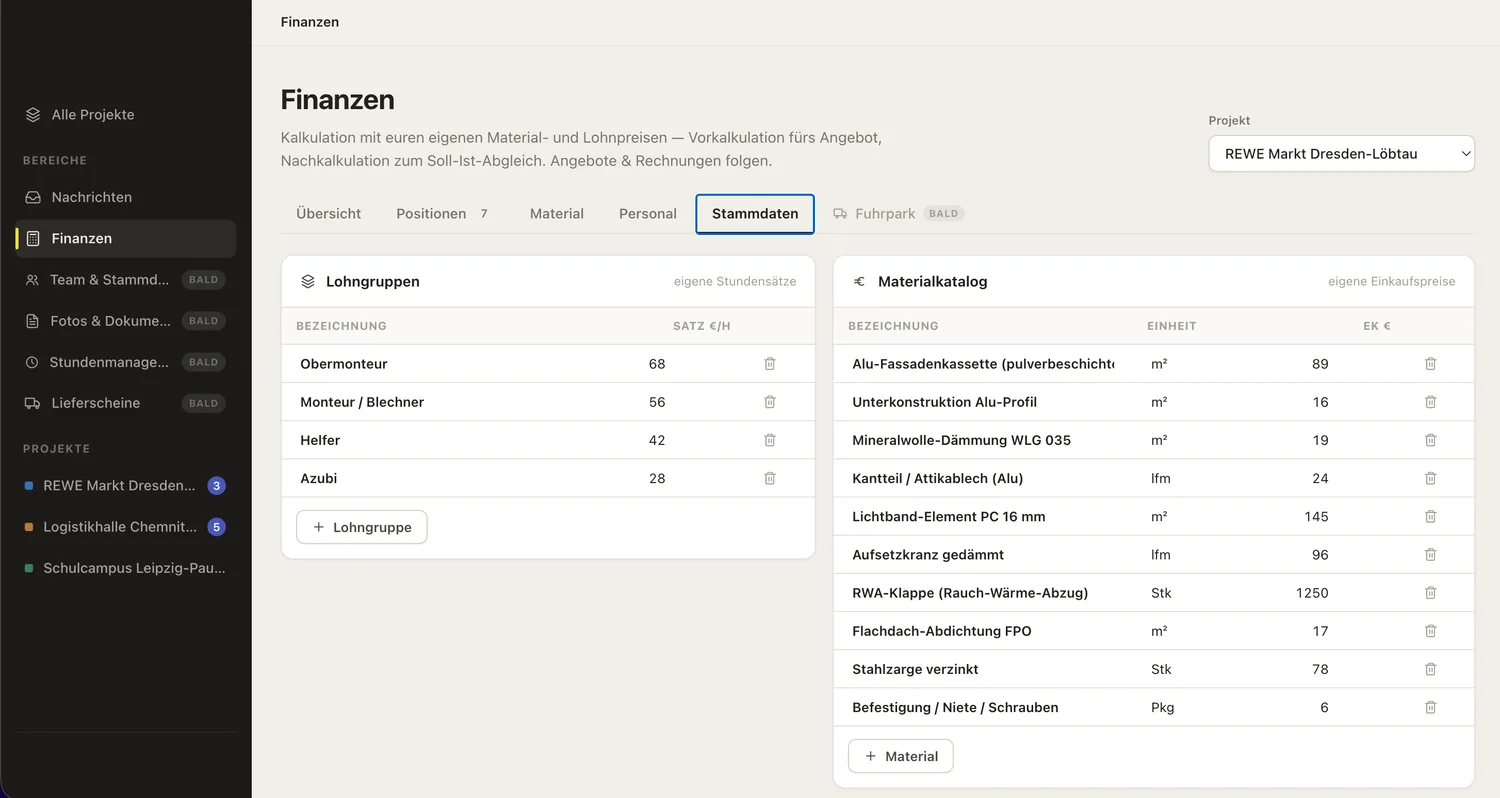
For a construction company we built a complete custom solution from scratch that brings costing, quotes, invoices and internal communication together in one place, instead of separate tools and spreadsheets.
Custom software that carries the day-to-day
From internal tool to connected platform, on their own or as one solution.
Custom web applications
Applications for your exact workflow, in the browser, no installation, on any device.
Internal tools and portals
Customer, partner or employee portals that standard software doesn’t cover.
Spreadsheet replacement
Move grown spreadsheets into a clean, multi-user application.
Interfaces and integration
Connect existing systems cleanly instead of copying data back and forth.
Mobile and offline applications
Capture on site, offline-capable, with automatic sync.
Maintenance and evolution
Your solution stays maintained and grows with you, instead of stalling after the project.
How does a custom software project work?
No mammoth project that only shows results after a year. We put a working solution into use early and evolve it together with you.
Process analysis
We look at your concrete workflows: which tools, which steps, where time is lost. The result is a clear list of the biggest levers.
Fixed-price calculation
You get a concrete proposal with a fixed price and timeline per block, including the spots where software adds nothing.
First block live
In short cycles we build the first usable block and put it into daily use, instead of developing hidden away for months.
Operation & growth
Further blocks come together in the central dashboard. We maintain, fold in feedback and keep evolving with your company.
What does custom software cost?
You get a calculated flat-rate offer. Upfront we agree together which processes are worth optimising, so every investment pays off through less time spent, lower costs and fewer headaches.
Frequently asked questions about custom software
When is custom software worth it over standard software?
Custom software is worth it over standard software whenever you can only map your process with workarounds, pay for many features you never use, or run several systems that don’t work together. As long as standard fits your workflow well, standard is the cheaper choice, and we’ll tell you that honestly. The moment the manual work around it takes over, a tailored solution plays out its advantage.
Do we have to replace everything at once?
No, you don’t have to replace anything at once. We start at one concrete bottleneck and extend the solution step by step. What you already have often stays in place and is simply connected cleanly.
What happens to our existing systems?
Your existing systems usually stay in place. Most projects don’t replace everything but close gaps and connect the software you already have. That way the manual work in between disappears, without you starting from scratch.
How quickly is a first version usable?
A first usable version is usually in place within a few weeks, not months. We work in short cycles and put an early building block into use quickly. From there the solution grows alongside your daily work.
Do we own the software in the end?
Yes, the finished software is yours, including the source code. You’re not tied to us and could hand over operations at any time in theory. That most clients keep working with us comes down to the result, not to a lock-in contract.
Custom software or industry software, which fits better?
Industry software fits as long as your business largely follows the industry standard and you work well with the intended feature set. Custom software is worth it once your workflow deviates from that, you run several industry tools in parallel, or your real edge lies in exactly this process. Often the best answer is a combination: the industry tool stays, and we add precisely what’s missing.
What does it cost to have custom software developed?
Custom software starts with us at around €16,700 for a first productive building block, at a fixed price. The overall investment depends above all on the scope of the first usable state, the number of systems to connect and the complexity of your rules. Because we deliver in building blocks, the entry stays predictable and grows with the value, instead of having to be fixed as one large budget up front.
How do I recognise a good custom software provider?
A good provider understands your process first and talks about results, not technologies. Look for fixed prices per building block instead of open timesheets, for early usable versions instead of months of black-box development, and for source code and solution belonging to you in the end. An honest “you don’t need that” is a better sign than a yes to everything.
Custom software in detail
Everything worth reading up on: when it pays off, how we work and what we watch for on control and data protection.
The honest order is: first check standard or industry software, then add custom pieces where needed. Standard wins for general tasks like bookkeeping or payroll, because maintenance, updates and compliance are baked into the licence price. Custom software wins where a process is your differentiator, where you bridge several tools by hand today, or where licence and workaround costs have long exceeded the standard price. What counts is the total cost over the years, not the entry price of a single tool.
We usually build custom software as a web application with a central data model, so every function works off the same current state instead of maintaining copies of data. Existing systems are connected API-first, through documented interfaces and webhooks; only where a system offers no interface at all does RPA come in as a fallback. Clear roles and permissions, a clean separation of data and interface, and open standards keep the solution maintainable and stop you from getting stuck in a proprietary format.
Instead of a big-bang project, we deliberately cut the first building block small, namely the bottleneck that slows you down most. This MVP goes into real use early, because software only shows what it truly needs to do with real data and real feedback. From there we iterate in short cycles and prioritise by value, rather than developing past your needs for months.
We work with fixed prices per building block instead of open timesheets, so the investment stays predictable. The effort is driven mainly by the scope of the first state, the number of integrations and the complexity of your business rules. Alongside development, the total cost includes operations, maintenance and further development; against it stand saved licences, less manual work and lower error costs. On request we spread the investment across building blocks and instalments, so each step can carry itself on its own value.
You receive the solution including source code and documentation, so you could switch providers or continue in-house at any time. Your data belongs to you and can be exported in open formats; there’s no lock-in to a proprietary system. On request we settle handover and access contractually, so data ownership and freedom to act stay with you for good.
We govern access through clear roles on a least-privilege basis, and sensitive actions stay traceably logged. The handling of personal data is arranged in line with the GDPR, including data processing agreements and hosting in the EU. For operations, automatic backups, monitored updates and documented maintenance keep your software running stably and maintained, instead of ageing after the project.