Guide · Custom software
Custom software or off-the-shelf: when is each worth it?
Off-the-shelf software or tailored software? A clear decision guide for SMEs: how to tell when standard is enough and when custom software really pays off.
 Richard Roth Strategie & Automatisierung August 24, 2026 7 min read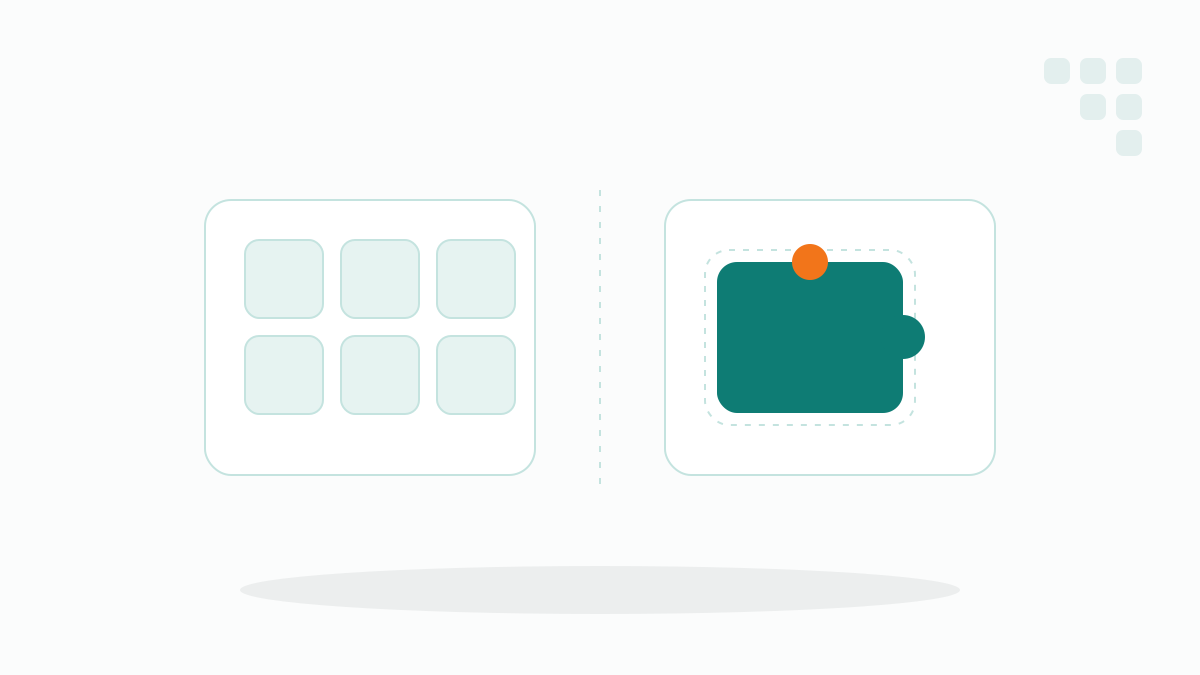
The question comes up in almost every digitalisation project: do we buy a ready-made solution off the shelf, or have something built that fits us exactly? Both routes are right, just not for every case. Off-the-shelf software is often the smarter choice, and custom software pays off above all where your own workflow is the competitive advantage. The skill lies in judging honestly where you actually stand.
- Off-the-shelf is the default for good reason: for common tasks like accounting or email, mature and affordable solutions already exist.
- Workarounds are a warning sign: if your team bridges a system with spreadsheets and sticky notes, it no longer fits.
- Your workflow is the lever: custom software is worth it when your specific process sets you apart from competitors.
- The middle path is often the answer: standard as a base, custom only where it really hurts.
What sets off-the-shelf and custom software apart
Off-the-shelf software is a finished product that many companies use at the same time: an accounting tool, a CRM, an inventory system bought as-is. It is proven, kept up to date, and you usually pay a manageable licence fee. The price for that: you adapt to the software, not the other way around.
Tailored software flips this around. It is built for your specific workflow and mirrors exactly how you work, without the ballast of features you never need. The price here: development and maintenance sit with you and your partner, not with a vendor serving thousands of customers.
Neither route is fundamentally better. They solve different problems.
When is off-the-shelf software perfectly enough?
For most everyday tasks, off-the-shelf software is the sensible choice, and for good reason. Where many companies need the same thing, the market is mature: the solutions are refined, the bugs long since found by thousands of users, and the costs spread across many shoulders.
Off-the-shelf fits well when:
- the task is common. Accounting, payroll, email or calendars work similarly everywhere, so reinventing the wheel rarely pays off.
- you want to start fast. A ready-made solution is up and running in days, not months.
- the process is not a differentiator. Your accounting doesn’t make you better than competitors, it just has to run reliably.
- the budget is small. A licence is almost always cheaper than in-house development.
A note upfront: if a standard solution covers 90 percent of your requirements, it is often smarter to adjust the remaining 10 percent in your workflow than to build your own software. Not every quirk in a company is worth casting in code.
How do I know custom software is worth it?
The turning point rarely arrives overnight. It creeps in, usually as a collection of small frictions that together become genuinely expensive. These signs show up again and again in practice:
- Your team builds workarounds. Alongside the actual system there are spreadsheets, sticky notes or a secret second database, because the software doesn’t reflect the real workflow.
- You juggle several systems. The same data is moved by hand from one tool to the next, because no standard solution can do it all together.
- You pay for features nobody uses. Expensive licences with a hundred features, of which your team needs three, and yet the one thing that matters is missing.
- Your workflow is your advantage. When the very way you work sets you apart, off-the-shelf software forces you into a process like everyone else’s.
The last sign in particular is often overlooked. If your process is the reason customers come to you, then it is too valuable to subordinate to software off the shelf. This is exactly where tailored software pays off. For more on how such a project runs, see our page on custom software.
The most common mistake isn’t the wrong choice between standard and custom, it’s spotting the turning point too late. We often see teams that have lived with workarounds for years and no longer even notice the effort, because it has become normal. So I ask first: what are you currently typing by hand from one system into the next? That’s almost always where the first real lever sits.
Off-the-shelf fits or custom pays off: the direct comparison
As a quick orientation, a side-by-side helps. The more points on the right apply to you, the more likely tailored software is worth it.
| Off-the-shelf fits when … | Custom pays off when … |
|---|---|
| the task is common and everyday | your workflow sets you apart from competitors |
| a ready-made solution covers 90 % | you connect several systems by hand |
| you want to start fast and cheap | your team permanently builds workarounds |
| the process is not a differentiator | you pay for unused licences and something is still missing |
| you can live well with the software’s rules | the software slows you down instead of carrying you |
Often the best answer is neither fully left nor fully right, but in between: proven off-the-shelf software as a base, complemented by a lean custom solution exactly where your day-to-day is defined. Instead of building everything yourself, it is often worth connecting existing systems cleanly and developing only what is truly your own.
Rule of thumb: build custom only what makes you unique. Buy everything else off the shelf. That keeps cost and maintenance effort where they genuinely pay off.
How to approach the decision pragmatically
You don’t have to commit all at once. The best starting point is an honest stocktake: where exactly does the friction sit in daily work, and what does that friction actually cost in time and nerves? Write down the two or three workflows that slow your team the most.
Then check, for each of those workflows, whether a standard solution exists that fits well enough. Only once you find that no ready-made software hits the core, or that this particular workflow is your advantage, does custom software become the topic. And even then the rule holds: start small, at a concrete point, rather than replacing a whole system at once.
That keeps the decision manageable and you see early whether the chosen path holds.
Frequently asked questions
Is custom software always more expensive than off-the-shelf?
Can I combine off-the-shelf and custom software?
What if a standard solution can do almost everything, but not quite?
How do I recognise the right moment to switch?
More articles
Custom software
Replace Excel: when a custom app beats the spreadsheet
Excel eventually hits its limits. How to tell when a custom app instead of Excel pays off, and when the spreadsheet is perfectly enough.
Custom software
Having custom software built: process, timeline and pitfalls
How does a custom software project actually run? The phases, a realistic timeline and the most common pitfalls when you have custom software built.

Custom software
What does custom software cost? Prices, models and cost factors
What custom software costs comes down to a few factors. A clear overview of pricing models, cost drivers and why starting small keeps the investment predictable.